
Artificial Intelligence vs Machine Learning vs Deep Learning (AI vs ML vs DL) is one of the most searched topics in technology today. Many people use these terms interchangeably. However, they are not the same. Each plays a different role in building smart systems. For example, voice assistants like Siri and recommendation engines on Netflix use these technologies.
In this guide, you will learn the key differences between AI vs ML vs DL. You will also explore real-world examples and applications.
Table of Contents
🤖What is Artificial Intelligence (AI)?
Artificial Intelligence is a branch of computer science. It focuses on building smart machines. These machines can mimic human intelligence. They can think, learn, and make decisions. AI includes simple rule-based systems. It also includes advanced technologies like neural networks.
👉 Want to explore tools? Check our guide on best AI tools for coding in 2026.
Key Characteristics of AI:
- Decision-making capability
- Problem-solving skills
- Learning and adapting
- Natural Language Processing (NLP)
Real-Life Applications:
- Chatbots (e.g., ChatGPT)
- Self-driving cars
- Smart assistants (e.g., Alexa, Siri)
- Fraud detection systems
Advantages of Artificial Intelligence:
Artificial Intelligence offers several benefits that are transforming industries worldwide:
- Automation of repetitive tasks – Reduces human effort and increases efficiency
- 24/7 availability – AI systems can work continuously without fatigue
- Improved accuracy – Minimizes human errors in data processing and decision-making
- Enhanced decision-making – Provides data-driven insights for better outcomes
However, AI also comes with challenges such as ethical concerns, job displacement, and dependency on data quality.
Fun Fact: The concept of AI was first introduced in the 1950s!
📊What is Machine Learning (ML)?
Machine Learning is a subset of AI. It allows machines to learn from data. Instead of following fixed rules, ML systems find patterns. Then, they make predictions or decisions.
Types of Machine Learning:
- Supervised Learning – Labeled data (e.g., spam email detection)
- Unsupervised Learning – Unlabeled data (e.g., customer segmentation)
- Reinforcement Learning – Learning through rewards and punishments (e.g., game-playing AI)
Real-Life Applications:
- Product recommendations (Amazon, Netflix)
- Email spam filters
- Stock market predictions
- Image recognition
Common Machine Learning Algorithms:
To better understand how machine learning works, here are some widely used algorithms:
- Linear Regression – Used for predicting continuous values
- Logistic Regression – Used for classification problems
- Decision Trees – Easy-to-interpret models for decision-making
- Random Forest – Combines multiple decision trees for better accuracy
- K-Means Clustering – Used in unsupervised learning for grouping data
These algorithms form the backbone of many real-world applications like recommendation systems and predictive analytics.
🧠What is Deep Learning (DL)?
Deep Learning is a part of Machine Learning. It uses neural networks with many layers. These networks are inspired by the human brain. They work well with large and complex data.
Why It’s Special:
- Automatically extracts features from raw data
- Requires large datasets and powerful GPUs
- Often more accurate than traditional ML (but also more complex)
Real-Life Applications:
- Facial recognition
- Self-driving vehicle vision systems
- Language translation
- Medical image analysis
Popular Deep Learning Models:
Deep Learning relies on different types of neural network architectures:
- Artificial Neural Networks (ANN) – Basic building blocks of deep learning
- Convolutional Neural Networks (CNN) – Best for image and video processing
- Recurrent Neural Networks (RNN) – Ideal for sequential data like text and speech
- Transformers – Power modern NLP models like ChatGPT
These models enable advanced capabilities like speech recognition, object detection, and language understanding.
Did you know? Deep Learning powered AlphaGo to beat the world champion in Go — a feat once thought impossible for AI.
Comparison Table: AI vs ML vs DL
| Feature | Artificial Intelligence | Machine Learning | Deep Learning |
|---|---|---|---|
| Definition | Simulates human intelligence | Learns from data | Uses layered neural networks |
| Data Requirement | Moderate | High | Very High |
| Hardware Needs | Low to Moderate | Moderate | High (GPUs) |
| Human Intervention | Often Required | Less | Minimal (Auto Feature Extraction) |
| Use Cases | Chatbots, robotics | Recommendations, predictions | Facial recognition, NLP |
How Are They Connected?
Here’s a simple way to understand the hierarchy:
Artificial Intelligence
└── Machine Learning
└── Deep Learning
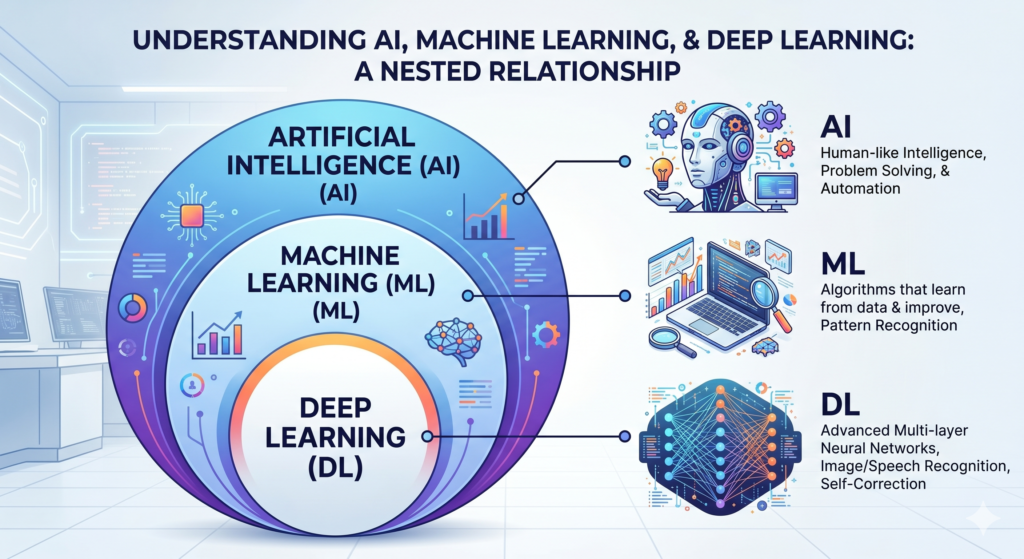
- AI is the overall science.
- ML is a branch of AI that focuses on learning from data.
- DL is a branch of ML that focuses on deep neural networks.
🔗 For a deep dive, check this MIT resource on AI vs ML vs DL.
Future of AI, ML, and DL
The future of Artificial Intelligence, Machine Learning, and Deep Learning is incredibly promising. As technology advances, we can expect:
- More personalized user experiences in apps and platforms
- Growth of autonomous systems like self-driving cars and drones
- Advancements in healthcare, including early disease detection
- Smarter business automation and predictive analytics
Companies like Google and Microsoft are heavily investing in AI research, making it one of the most in-demand skills in today’s job market.
Skills Required to Learn AI, ML, and DL
If you’re planning to build a career in this field, here are some essential skills:
- Programming (Python, R)
- Mathematics (Linear Algebra, Statistics, Probability)
- Data Handling & Visualization
- Understanding of Algorithms & Data Structures
- Frameworks like TensorFlow and PyTorch
Conclusion
In summary, understanding AI vs ML vs DL is essential for anyone entering the tech world. Each plays a unique role in building intelligent systems, and together they power the future of innovation.
Whether you’re a tech enthusiast, business leader, or aspiring developer, knowing these distinctions gives you a clearer view of the digital future.
FAQs
Q1: What is the difference between AI vs ML vs DL?
A: AI is the broader concept of machines simulating human intelligence, ML is a subset that learns from data, and DL is a specialized form of ML using neural networks.
Q2: Is Deep Learning better than Machine Learning?
A: It depends on the use case. Deep learning performs better with large datasets and unstructured data but is more resource-intensive.
Q3: Can you use Machine Learning without AI?
A: No, ML is a subset of AI, so it falls under the broader umbrella of AI.
Q4: What should I learn first — AI, ML, or DL?
A: Start with AI basics, then move to ML, and finally explore DL once you’re comfortable with machine learning foundations.